Factum
This article examines the political and constitutional implications of the non-ratification of the Referendum Ordinance 2025, evaluating whether the newly elected Parliament’s actions can be challenged under the writ jurisdiction of the High Court Division. On 5 August 2024, a student-led mass movement, popularly known as the Long July or July 36, brought down the Awami League Government led by Sheikh Hasina. The nation was informed that PM Hasina had resigned and fled to India to escape mass wrath, and the President accepted her resignation and dissolved the Parliament.[1] What follows describes political and administrative measures undertaken to address the national crisis by filling the leadership vacuum in the executive branch of the government machinery.
The student leaders convinced Professor Dr. Muhammad Yunus to fill the leadership vacuum, and the President and the Army yielded to their demand.[2] On 8 August, he was sworn in as the Chief Advisor of an Interim Government. At that time, Professor Yunus was hailed as a national hero for shouldering the national crisis at the age of 85. Today, it is difficult to believe that he really made a rational and judicious decision at this stage of his life. When this issue is discussed, say, after half a century, the analysts will have no recollection of what happened during the period leading up to the Long July. They will draw conclusions about Professor Yunus’s role in that critical juncture of our national life based on historical records distilled as the true reflections of the Long July events. Let us leave him alone without blaming those who have been assailing his character. History will definitely judge them, which will be a regrettable experience for their descendants.
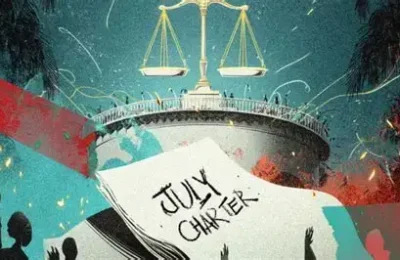
Professor Yunus’s most admirable accomplishment is the July Charter, which was signed by 26 political parties and the Interim Government on 17 October 2025 at the South Plaza of the Jatiya Sangsad Bhaban.[3] The Charter outlines 84 reform proposals to overhaul the country’s inefficient and corrupt public administration. The most significant of these proposals is the introduction of a bicameral legislature that combines features of majority-voting and proportional-representation systems. The 300 seats in the lower house are filled directly by majority vote, while the 100 seats in the upper house will be filled indirectly through proportional representation.
To ensure that the elected government honours its promise under the July Charter, the Bangladesh Parliament Secretariat arranged two oath-taking ceremonies for the newly elected MPs: the first to take the oath as members of Parliament, and the second to take the oath as members of the July Charter Implementation Committee. BNP, which has received a more than two-thirds majority in the lower house, and is the legal and legitimate candidate to form the government, refused to take the oath at the second ceremony. Home Minister Salahuddin Ahmed has explained the BNP’s position on this. He said that the Constitutional Reform Commission formed by the Interim Government is unconstitutional. This is because it must be established through parliamentary debates, as the referendum verdict requires amending the Constitution.[4] The Constitution can be amended only by the elected members of Parliament, meaning that only Parliament can arrange a referendum.
This event was more remarkable than anything that happened after the 13th parliamentary elections on 12 February 2026. This author is unaware of anyone knowing of this U-turn by the BNP, which it did without any apology. In fact, declining to take the oath at the second swearing-in ceremony represents a significant departure from the established political consensus, which all past ruling parties have demonstrated. What BNP has not done is in accordance with the country’s political culture. The curious question that political and legal analysts have not addressed is how and why this culture has developed in the country.
- 5 August 2024: Government resignation and dissolution of Parliament following the “Long July” movement.
- 17 October 2025: The ‘July Charter’ is signed by 26 political parties and the Interim Government.
- 12 February 2026: 13th Parliamentary Elections and concurrent National Referendum take place.
- 3 March 2026: High Court Division issues four Rule Nisi orders questioning the legality of the Referendum Ordinance.
The Rulings
BNP was well aware that the opposition would pose serious challenges to this U-turn in the maiden session of the 13th Parliament, to be convened on 12 March. As a precaution, it made the referendum issue sub-judice. A High Court Division bench comprising Justice Razik-Al-Jalil and Justice Md Anowarul Islam issued four separate Rule Nisi orders on 03 March, questioning the legality of the July National Charter (Constitutional Reform) Implementation Order, the oath administered to members of the Constitutional Reform Council, and the Referendum Ordinance.[5] These Rules were issued following two writ petitions filed by senior Supreme Court lawyers.[6] The court made the following authorities as respondents: the secretaries of law, cabinet, and Jatiya Sangsad; the prime minister’s principal secretary; the Election Commission; and the chief election commissioner. They were asked to answer these rulings within four weeks.
The court asked the respondents to explain why the provision in the implementation order of the July National Charter (Constitutional Reform), 2025, for a “yes” or “no” vote in a referendum and the letter issued by the parliament secretariat on 16 February to lawmakers for taking oath as members of the Constitution Reform Council should not be declared void and unconstitutional. It also asked them to show why Schedule-3 of the Referendum Ordinance, 2025, containing the 30 proposals on which the political parties reached consensus, should not be declared unlawful and unconstitutional.
The current political status of the HC ruling is now unclear because of the actions taken by the government during the first session of the 13th Parliament, convened on 12 March. The Interim Government promulgated 133 ordinances, of which 123 were made laws. From the remaining 20 ordinances, seven were repealed by four bills, and the 13 others automatically expired because parliament failed to ratify them within the constitutionally mandated 30-day period.[7] The most important one of these seven lapsed ordinances is the referendum, which proposed a bicameral legislature formed based on both majority and proportional representation. Since the referendum ordinance was not ratified, the HC ruling is no longer valid. This does not mean that political complexity is over, because it concerns the very foundations of democratic governance.
Analysis
Accordingly, the HC ruling needs to be examined from a political perspective. Under Article 102 of the Bangladesh Constitution, a Bangladeshi citizen can file a writ petition with the HC to challenge the illegal actions or decisions of executive bodies.[8] Clause 1 of Article 102 authorises HC to issue any appropriate order or pass a direction for the enforcement of any fundamental rights of a citizen. Clause 2 lists five categories of writ under which a petition may be submitted: (i) certiorari, (ii) mandamus, (iii) prohibition, (iv) habeas corpus, and (v) Quo Warranto.[9]
Under certiorari, the petitioner can challenge an ultra vires act or proceeding of an executive body. A writ of mandamus is a type of writ which allows the Court to direct the executive body to do what it is required by law to do. The administrative bodies often do not exercise their power as conferred by the law or sit idle, in which case an aggrieved citizen can resort to the writ forum, and the relief granted by the Court in the writ of mandamus is in the form of a mandatory injunction directing the concerned executive body to do the act in accordance with law.
In the case of a writ of prohibition, the HC Division directs the government authority to refrain from doing that which it is not permitted by law to do. In both cases, HC grants remedies that are generally in the nature of injunctive relief. A writ of habeas corpus permits the Court to require that any person who is a subject of illegal detention or held in custody in an unlawful manner be brought before it, and the Court can then examine the legality of such detention or confinement. Finally, the writ Quo Warranto, a Latin term, means ‘under what authority’. It is often the case that a person is holding a post in the Government or public office without being duly appointed in accordance with the law. Therefore, HC is vested with the power to require the said person to provide an explanation of the authority under which he/she is holding such public office.
Based on the locus standi or right to sue, a writ can be filed under two categories: individual and representative. An aggrieved individual may file a writ challenging the decision or action of a public authority or the consequence of that action, meaning the individual must have a sufficient interest in the matter to which the writ petition relates.[10] On the other hand, a representative writ suggests a petition filed in the public interest. This is a serious matter for which HC is supposed to be extra careful to entertain such writs.
Observations and Conclusions
The first point to note is that this HC ruling is no longer legally valid, suggesting that further discussions on the subject carry little significance under judicial review. On the contrary, it is argued that the legal issue raised by this ruling has become very critical in determining the nature of the democratic culture to be practised in the country.
Since the writ concerns the legality of holding a referendum by an interim government, no Bangladeshi citizen is individually qualified to file the writ because the writ petitioner cannot demonstrate “sufficient” interest or involvement in the matter. Therefore, the writ must be filed under the representative category. The referendum was approved by 68% of “Yes” votes, meaning 32% said “No.”[11] However, the two advocates who filed the petition can justify their locus standi under Article 102 as representatives, i.e., they represent 32% of the voters in the referendum, which is satisfied by non-ratification.
However, the non-ratification has established a solid writ challenge for the “Yes” voters in the referendum. A general poll is a matter of “voter trust,” by which people delegate their sovereign power vested in the government to some of their fellow citizens. On 12 February, the Interim Government held a general poll in which voters cast two kinds of ballots: one, called the elections for the 13th parliament, to choose a party to govern during its tenure, and the other, called the referendum, to implement various constitutional reforms agreed in the July Charter. All contesting parties have accepted the election verdict, in which the BNP has returned with more than a 2/3 majority in parliament. In terms of popular votes, the party’s share was 49.63%, meaning 50.37% voters cast ballots for other candidates. Despite this difference in popular vote between the election and the referendum, both verdicts are legal under the country’s electoral rules. BNP formed the government by virtue of its majority, which the nation hailed, and the opposition accepted honourably.
However, BNP created a major political crisis in legitimising the election verdict by refusing to accept the popular verdict given by the referendum. The opposition is now a legal body governed by parliamentary rules, i.e., it must accept the government’s actions regarding the referendum. In this situation, the burden of correcting the “political wrong” committed by BNP falls on ordinary people, as it did in 1990 and 2024.
This option is time-consuming as ordinary people have to be mobilised to be mentally prepared for the utmost sacrifices. However, the second option seems perfectly feasible and reasonable because such a challenge falls well within the High Court’s writ jurisdiction. The failure to ratify the referendum verdict is tantamount to the BNP’s “breach of promise” given through its election platform and participation in the deliberations of the National Consensus Commission and the Constitution Reform Commission. From a jurisprudential perspective, this situation invokes the Doctrine of Legitimate Expectation.[12] The Interim Government’s promulgation of the Referendum Ordinance, combined with the political consensus of the July Charter, created a legitimate expectation among the electorate that the mandate would be ratified.
Writ petitioners, representing the 68% voters who approved the referendum, can challenge the “legitimacy” of the BNP government’s inaction in the HC on the accusation that it has violated the voters’ trust by failing to ratify the referendum mandate.
BNP cannot form the government and run the Parliament by bypassing the popular verdict given through the referendum, while taking advantage of the voters’ choice in the election part of the national poll.
- 1. Bangladesh Constitution: Context and Cases (2nd edn, Law House 2025) 45. ↩
- 2. ‘Interim Government Sworn In, Professor Yunus Assumes Chief Advisor Role’ The Daily Star (Dhaka, 9 August 2024) 1. ↩
- 3. July National Charter (Constitutional Reform) Implementation Order 2025. ↩
- 4. Constitution of the People’s Republic of Bangladesh, art 142. ↩
- 5. Writ Petition No 2045 of 2026 (HC, 3 March 2026). ↩
- 6. Writ Petition No 2045 (n 5). ↩
- 7. Constitution of the People’s Republic of Bangladesh, art 93(2). ↩
- 8. Constitution of the People’s Republic of Bangladesh, art 102. ↩
- 9. Mahmudul Islam, Constitutional Law of Bangladesh (3rd edn, Mullick Brothers 2012) 650. ↩
- 10. Dr Mohiuddin Farooque v Bangladesh (1997) 49 DLR (AD) 1. ↩
- 11. Election Commission of Bangladesh, Official Gazette Notification: Referendum Results 2026 (18 February 2026). ↩
- 12. Bangladesh Sthapatya Adhidaptar Diploma Prokoushouli Samity v Bangladesh (2008) 60 DLR (HCD) 684. ↩
Frequently Asked Questions
What is the July Charter of 2025 in Bangladesh?
The July Charter, officially signed on 17 October 2025 by 26 political parties and the Interim Government led by Prof. Muhammad Yunus, outlines 84 constitutional reform proposals, most notably the introduction of a bicameral (two-house) legislature.
What is the proposed bicameral legislature in Bangladesh?
The July Charter proposed splitting the parliament into two houses: a lower house with 300 seats filled directly by traditional majority voting, and a new upper house with 100 seats filled indirectly through proportional representation.
Why did the BNP refuse to ratify the 2026 Referendum?
Despite winning a two-thirds majority in the 13th parliamentary elections, the BNP government refused to ratify the referendum mandate. They argued that constitutional reforms must be debated and amended exclusively by elected members of Parliament, rather than through an Interim Government ordinance.
Can the High Court rule on the 2026 Referendum ordinance?
Following representative writ petitions, the High Court Division initially issued Rule Nisi orders questioning the legality of the Referendum Ordinance. However, because the newly elected parliament failed to ratify the ordinance within 30 days, it automatically expired, leaving the High Court ruling legally void but politically complex.
How does the Doctrine of Legitimate Expectation apply to the referendum?
Legal analysts argue that by passing the Referendum Ordinance and holding a national vote (which received 68% approval), the Interim Government created a strict “legitimate expectation” among the electorate that their mandate would be implemented, setting grounds for potential writ challenges against the new government’s inaction under Article 102.