Introduction
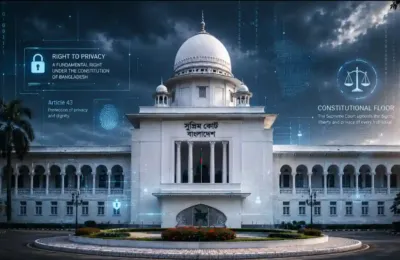
The Jatiya Sangsad (JS) passed the Constitution (Sixteenth Amendment) Act, 2014, on 7 September 2014, which authorised the JS to impeach the judges of the Bangladesh Supreme Court on charges of misconduct and/or incapacity.[1] On 5 November 2014, nine SC lawyers filed a writ petition with the High Court division, arguing that the amendment was ultra vires the Constitution. A Special Bench of the High Court Division, consisting of three judges, upheld the writ petition on 5 May 2016 by a majority, and declared the impugned amendment colourable, void, and ultra vires the Constitution. The government appealed to the Appellate Division, which upheld the HC verdict on 3 July 2017.[2] What happened in the aftermath of the verdict will remain a black spot in Bangladesh’s judicial history. It will remind future Bangladeshi generations how irresponsible a political party, led by the daughter of the Father of the Nation, can be.
The problem addressed in this article is not to examine the merits and demerits of the SC verdict, on which a rich literature exists. Instead, we will examine whether the Bangladesh Parliament, and all others in general, have a legitimate right to impeach SC judges under the theory of democracy on which our Constitution is founded. This impeachment law will lack democratic legitimacy if it cannot be justified theoretically. Examining this issue is critical for good reasons: First, SC judges are legal experts appointed according to the rules of public service; public servants do not need to be impeached to be removed from office. Second, and more importantly, they do not enjoy any executive power that is protected by the Constitution. The concept of impeachment historically refers to public officials holding the highest level of executive power.
Impeachment of the Head of State under the Theory of Democracy
Our discussion concerns the rules of impeachment in parliamentary democracy. According to the theory of democracy, the state belongs to the people collectively, whose sovereign authority is vested in the government. The government is a bureaucratic organisation managed by various professionals, recruited, trained, and promoted through its human resources division. However, the administrative responsibility of the government is vested in its political component, which is elected.
There are two forms of administration in democracy: presidential and parliamentary. In the presidential form, the administrative head, i.e., the President, is directly elected, thereby holding two posts simultaneously: head of state and head of government. To restrain the president from abusing executive power, the president must have all bills passed in the parliament. The final restraint on the president is the parliament’s right to impeach the president for misconduct.
In the parliamentary system, the two highest offices of government are held by two different persons. Voters elect members of the parliament, and the president appoints the leader of the majority party as the head of the government. The office of the Head of State is ceremonial because the occupier of this office has no executive authority, although all bills passed by Parliament require the President’s consent to become law. Removing the Head of the Government, i.e., the Prime Minister, does not require any impeachment because a “no-confidence” motion is enough to force the PM to submit a resignation to the President. However, the president, who is appointed by the parliament, is removable from office only through impeachment because he enjoys immunity from ordinary civil and criminal laws as the most honourable individual in the state.
The question before us is to examine whether the parliament has constitutional authority to impeach the Chief Justice and other members of the Supreme Court, as proposed by the 16th Amendment. Under Article 95(1) of the Constitution, the President is authorised to appoint the Chief Justice without consulting the Prime Minister.[3] He/she appoints other members of the Appellate and the HC divisions by consulting the CJ. These are the points to note: First, judges are legal bureaucrats, not public officials elected to their offices. Second, the parliament is not involved in their appointment. Third, they have no executive power other than that assigned by the Law Ministry. All these points lead to genuine curiosity about why the AL government, under the leadership of Sheikh Hasina, took such an interest in impeaching the judges.
- 1972: Constitution empowers Jatiya Sangsad to remove judges.
- 1975: Fourth Amendment transfers power exclusively to the President.
- 1978/79: Supreme Judicial Council (SJC) established via martial law and the Fifth Amendment.
- 2011: Fifteenth Amendment formally codifies the SJC into law.
- 2014: Sixteenth Amendment attempts to revert removal power to parliament.
A Brief History of Judicial Impeachment in Bangladesh
The 1972 Constitution empowered the JS to impeach SC judges for misconduct and incapacity.[4] This provision was changed in January 1975 by the 4th Amendment; the power was transferred to the President.[5] The reason was that parliament had changed the system of government from a parliamentary to a presidential form. When General Ziaur Rahman seized power in 1978, he established a Supreme Judicial Council (SJC) to address issues through a martial law proclamation. The Council would consist of three members, including the Chief Justice as the head and two most senior members of the appellate division. In case the Council gets involved in inquiring into the capacity or conduct of its own member, the next most senior judge of the appellate division will take his/her place.
The main functions of the Council included preparing a code of conduct to be observed by the judges and conducting an inquiry into their capacity or conduct. The Council was authorised to initiate such an inquiry only upon being instructed by the President, who receives such information from the Council and/or from any other source. If the Council recommends the removal of the accused judge, he/she shall be removed by the President from office. In conducting this inquiry, the Council shall follow the same procedure as the Supreme Court does and have the same power. This judicial provision was validated in the Constitution through the 5th Amendment in 1979, along with other amendments introduced through martial law proclamations.[6]
In 2010, the SC declared all constitutional changes made under the 5th Amendment null and void, though the SJC provision was retained.[7] The AL-led coalition government made the SC decisions law in 2011 through the 15th Amendment, which retained the SJC provision.[8] The 16th Amendment replaces the SJC system first introduced through the 5th Amendment and reaffirmed by the 15th Amendment. It replaces clauses (2) through (8) of Article 96 of the Constitution with new clauses (2), (3), and (4). According to the new clause (2), the President shall remove a judge from office when parliament impeaches him/her, with a minimum of two-thirds majority of members present, on the grounds of proven misconduct or incapacity. Clause (3) states that parliament shall regulate the procedure of investigation and decide the method for proving misconduct or incapacity of the accused judge.
Political Logic behind the Judicial Impeachment Drama in Bangladesh
The idea of impeaching SC judges was introduced in the 1972 Constitution. In Part VI, titled “The Judiciary,” Article 96 states that a Judge can hold office until attaining the age of sixty-five years (later changed to 67). He cannot be removed from office ‘except by an order of the President passed pursuant to a resolution of Parliament supported by a majority of not less than two-thirds of the total number of members of Parliament, on the ground of proved misbehaviour or incapacity.’[9]
The reason why this provision was included is unknown. However, a picture can be envisioned by reviewing the political circumstances in which the country earned independence and the urgency of drafting a constitution to hold an election. It does not seem unreasonable to assume that the drafters did not consider this article truly important and inserted it for the sake of completing the relevant part of the Constitution. The handy example before them was the US Constitution, because the Proclamation of Independence on 10 April 1971 was styled after the American Declaration of Independence. Due to time constraints, the Constitution drafters missed the point that America practised a presidential system of government, while we chose a parliamentary one. In America, both the President and the Senate are inseparably involved in the appointment of the Justices of the Supreme Court. In Bangladesh, the Parliament plays a limited role, if any, in the judiciary’s functioning under the Supreme Court.
The constitutional law impeaching the judges of the Supreme Court has little democratic virtue, certainly in Bangladesh. All the legislative measures taken by the three governing parties, AL, BNP and JP, concerning the supervision of the action and behaviour of our SC judges simply demonstrate their lack of knowledge and respect for the system of democratic governance. Blaming AL alone will represent an incomplete, if not biased, view. However, this political drama of impeaching judges will remain half-narrated if we ignore the role of officials and practitioners within the judiciary.
In our political discussion, we have created an image of a parliament that represents the people, the state’s sovereign authority. Accordingly, it is argued that this political branch of the government has the constitutional right to poke its nose into any matter in the republic it feels appropriate, which is theoretically and factually faulty. In a democracy, the sovereign authority of the people is neither divisible nor alienable, as Rousseau so beautifully explained in his classic Social Contract.[10] Then the idea of representing the people in a parliamentary system is fundamentally flawed because each member is elected for a particular voting district.
This theoretical difficulty with the popular perception of parliament’s role must be combined with the practical difficulty that each elected member is an individual. Accordingly, they cannot be expected to formulate laws of governance with common motives and devotion. However, they can be persuaded to regulate their legislative behaviour by defining the limits of their right. The perception that motivated the 16th Amendment is factually faulty.
Similarly, we assume the Supreme Court to be the custodian of the Constitution. Like the parliament, the SC is made up of individuals, so the above logic applies to its judges as well. The members of our judiciary are partners in crime if we blame the members of our parliament. As the constitutionally authorised interpreter of the Constitution, the SC is supposed to make an in-depth analysis of the writ or reference submitted to it to determine whether the case falls within its jurisdiction. The most notorious example is the writ on the caretaker government. The HC branch of the SC could decline to accept the writ, saying that it is a political issue of national consequence, which should be settled through the political process. Not only does the SC often act beyond its jurisdiction, but the history of Bangladesh’s SC testifies that its members, including the Chief Justice, behaved unprofessionally.
The final point to be noted is the behaviour of lawyers practicing in the SC system. The court is a campus-based institution established to settle disputes. Although a case may be politically motivated, its disposition cannot be made from a political perspective. Accordingly, the lawyer’s partisan identity must not play any role in the court premises. This is the norm of the legal profession practised worldwide, except for Bangladesh. Filing a writ petition is the most outrageous example in Bangladesh. In terms of professional ethics, our judiciary is no less guilty than our parliament.
Conclusion
Let us now discuss the key takeaways from this discourse. The first point that emerges from this discussion is that the entire discourse is conducted under the assumption of a democratic system of governance, but the experts involved do not necessarily agree on a precise definition of the concept. Perhaps, a clear understanding of the concept of democratic governance is yet to be reached.
Second, the principle of the separation of powers ordains that each branch of government has distinct functions to perform, which will ensure that the government, as an institution exercising the sovereign power of the people, can carry out its constitutional mandate. This constitutional principle is violated when any branch of the government over- or under-exercises its authority. In the case of the 16th Amendment, the Parliament over-exercised its constitutional mandate. Under a parliamentary democracy, the executive branch cannot, and should not, interfere with the activities of the judiciary, meaning impeaching the judges for misconduct or incapacity does not lie within the parliament’s power.
On the other hand, the judiciary exceeds its constitutional jurisdiction when it takes up writs that fall outside its jurisdiction. In the legal literature, this unconstitutional behaviour of the judiciary is called “judicial activism.” Perhaps existing and aspiring legal writers should pay more attention to this issue, as writs that the HC often entertains do not clearly fall within its jurisdiction.
- 1. Constitution (Sixteenth Amendment) Act 2014. ↩
- 2. Government of Bangladesh v Advocate Asaduzzaman Siddiqui (2017) 69 DLR (AD) 1. ↩
- 3. Constitution of the People’s Republic of Bangladesh 1972, art 95(1). ↩
- 4. Constitution of the People’s Republic of Bangladesh 1972, art 96 (original text). ↩
- 5. Constitution (Fourth Amendment) Act 1975. ↩
- 6. Constitution (Fifth Amendment) Act 1979. ↩
- 7. Bangladesh Italian Marble Works Ltd v Government of Bangladesh (2010) 62 DLR (SPL) 70. ↩
- 8. Constitution (Fifteenth Amendment) Act 2011. ↩
- 9. Constitution of the People’s Republic of Bangladesh 1972, art 96 (original text). ↩
- 10. Jean-Jacques Rousseau, The Social Contract (first published 1762, Penguin 1968). ↩
Recommended Reading
A Sketch of the Impeachment of Judges of the Supreme Court of Bangladesh
This article examines the 16th Amendment, the power to remove Supreme Court judges, the role of the Supreme Judicial Council, judicial independence, and the constitutional debate surrounding parliamentary impeachment in Bangladesh.