Introduction
When the July Mass Uprising of 2024 forced a reset in Bangladesh’s political trajectory, reform became both a moral demand and a political promise. Six reform commissions proposed 166 major changes, which were subsequently consolidated into the “July National Charter 2025”. On October 17, 2025, the Charter was formally signed by the National Consensus Commission and 25 political parties. However, less than a month later, the interim government issued the “July National Charter (Constitutional Reform) Implementation Order, 2025,” triggering an immediate legal crisis.
The Statutory Conflict
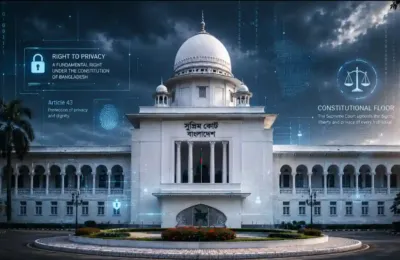
Article 80 of the Constitution strictly bars the passage of an Act without Parliament. The only available alternative is an Ordinance under Article 93; yet, the President cannot promulgate an Ordinance that contradicts the Constitution or addresses matters beyond legislative competence. Constitutional scholars argue that establishing a “Constitutional Reform Council” inherently conflicts with the Constitution, making the Implementation Order legally questionable.
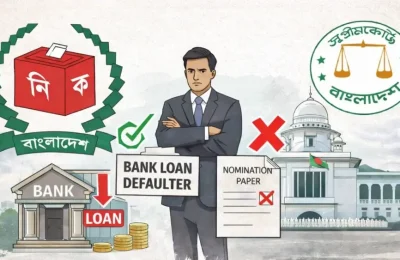
Complications multiply across operational frameworks. Article 119 restricts the Election Commission strictly to conducting presidential and parliamentary elections, providing zero legal authority for the Chief Election Commissioner to administer oaths to a new Constitutional Reform Council. Furthermore, Article 142 mandates explicit parliamentary approval prior to initiating any referendum.
Judicial Precedent & Vulnerability
The interim government assumed office under the existing Constitution rather than suspending it to seek a fresh mandate. Having taken an oath within this structural framework, the government remains strictly bound by its constraints. Article 7B’s basic structure doctrine prohibits changes that undermine the Constitution’s foundational framework.
- Fifth and Seventh Amendments: Declared unconstitutional for validating martial law regimes and extra-constitutional changes to the Constitution.
- Eighth Amendment (Partially): Partly struck down by the Supreme Court in relation to the creation of permanent High Court benches outside Dhaka.
- Thirteenth Amendment: Declared unconstitutional by the Appellate Division, affecting the non-party caretaker government framework.
- Fifteenth Amendment (Partially): Key provisions were declared unconstitutional by the High Court, including the abolition of the caretaker government system, removal of the referendum mechanism, and insertion of Articles 7A and 7B.
- Sixteenth Amendment: Declared unconstitutional for transferring the power to remove Supreme Court judges from the Supreme Judicial Council to Parliament.
These precedents establish a definitive legal reality: constitutional amendments and referendum outcomes remain heavily subject to judicial review. Swearing to uphold the Constitution while attempting to alter its core architecture renders the July Charter extremely legally vulnerable.
Political Execution Strategy
The political understanding dictates that whichever party forms the next government will implement the Charter alongside its specific dissenting positions. The Bangladesh Nationalist Party (BNP) has declared it will execute the Charter “in letter and spirit” once elected, incorporating the reforms through formal constitutional amendment.
The government’s initiative to implement the July Charter through constitutional amendments is consistent with the constitutional framework of Bangladesh. Article 142 vests Parliament with the authority to amend the Constitution, making it the constitutionally recognised mechanism for introducing reforms. To facilitate this process, the government has recently proposed a special parliamentary committee comprising representatives from both the treasury and opposition benches to examine and draft the necessary amendments. Since the July Charter’s proposals require changes to constitutional provisions, implementing them through this committee and the parliamentary amendment process ensures legal validity, democratic legitimacy, and adherence to the rule of law. From this perspective, constitutional amendment is not an alternative to reform but the constitutional means of achieving it.
Strategically, the NCP–Jamaat alliance engineered Clauses 18 and 19. These clauses propose an Upper House and mandate a two-thirds majority in the Lower House, plus majority support in the Upper House, for any constitutional amendments. The calculated objective is to prevent unilateral dominance by the BNP.
However, raw political arithmetic nullifies this anticipated structural restraint. BNP already commands more than a two-thirds majority in the Lower House. Under proportional representation in the proposed Upper House, BNP—together with independent support—could secure roughly 59 percent. Ultimately, BNP could plausibly argue it is merely executing the signed Charter while maintaining absolute operational control.
Conclusion
Attempting structural reform within an unchanged constitutional framework creates a severe collision between political aspiration and legality. The “July National Charter (Constitutional Reform) Implementation Order, 2025” lacks constitutional authority and faces immediate gridlock. In Bangladesh, constitutional reform is a test of legal endurance; the current framework remains highly vulnerable to judicial invalidation.