01. Introduction
Deepfake law in Bangladesh has become a critical topic as artificial intelligence quietly gives birth to a new kind of digital assault that may damage someone’s honour without leaving a trace. For decades, a photograph was considered proof and a video was considered undeniable evidence, but today, both can lie.
A stolen photograph and a few clicks can thoroughly change someone’s entire identity. AI can make hyperrealistic deepfakes by changing or synthesizing text, photos, video, and audio, which commonly appear to be real. In 2017, a moderator on the Reddit forum “Deepfakes” created the first deepfake by putting pornographic films featuring celebrity faces on adult actors’ bodies.[1]
02. The Deepfake Impact
Social media platforms, such as Facebook, Instagram, and Twitter, have developed into straightforward tools for rapidly spreading material with strong opinions, either favourable or negative. To reinforce gender standards and nationalist scripts that portray someone as immoral or unstable, visual manipulations (such as memes, altered screenshots, and deepfakes) attempt to arouse feelings of shame, disgust, and moral outrage.[2] Fraudsters currently use artificial intelligence to manipulate stocks and commit other financial crimes, endangering society. They already mimic bank employees over the phone by using artificial intelligence (AI)-generated fake audio to ask for unexpected cash transactions, bank account OTPs, and bank card details.[3] Soon, artificial superintelligence will be able to mimic live video calls, endangering more lives and causing more damage.
A news media company can acquire a competitive advantage by breaking news first and obtaining video footage from witnesses. In the rush to win a race, people often fail to verify the authenticity of videos of protests, accidents, fake speeches, and other events, including misleading captions that may cause panic elsewhere.[4]
Syeda Rizwana Hasan, former advisor to Bangladesh’s Ministry of Environment, was targeted in early 2025 when a doctored image – placing her face onto a body sourced from an adult website – was widely circulated on social media platforms through an account called “Chemical Ali”, known for repeatedly targeting prominent women.[5] As the Ministry of Information and Broadcasting recently reported, it identified 137 fake Facebook accounts, pages, and groups impersonating prominent individuals; 16 misinformation-based websites designed to resemble legitimate news outlets; more than 300 misleading Facebook accounts; and 100 accounts on X involved in spreading false information.[6]
03. Legal Framework and Deficiencies in Bangladesh
In Bangladesh, individuals can face civil and criminal consequences for acts of defamation. One can submit a defamation complaint to initiate legal proceedings regarding deep-fake offences.[7] However, in Bangladesh, the concept of defamation is often misapplied. According to section 499 of the Penal Code 1860, any person who, by spoken or written words, or through signs or visual representations, makes or disseminates any statement about someone with the intent to cause harm, or with knowledge or reason to believe that such statements will damage the individual’s reputation, is considered to have defamed that person, except in specific circumstances outlined thereafter.
Anyone found guilty of defaming another individual may face simple imprisonment for a duration that could reach up to two years or with a fine, or with both, under section 500 of the Criminal Code 1860. However, most defamation lawsuits in Bangladesh are primarily initiated for harassment. As a result, defamation cases are often dismissed in lower courts at quite low expense.[8]
To prevent the misuse of crimes associated with defamation, there was an additional law, the Digital Security Act of 2018. However, this legislation fails to prevent the exploitation of defamation offences. The Cybersecurity Act (CSA) 2026 has been enacted in Bangladesh, repealing the Digital Security Act and the previous Cybersecurity Act. It creates bodies such as the National Cybersecurity Agency to address cybercrime and empowers authorities to rapidly remove harmful AI-generated content and misinformation from social media platforms.[9] This act lacks explicit procedural safeguards. There is no statutory requirement for the state to alert the content creator, no mechanism for a pre-enforcement adversarial hearing, and no recourse for accelerated judicial review.[10]
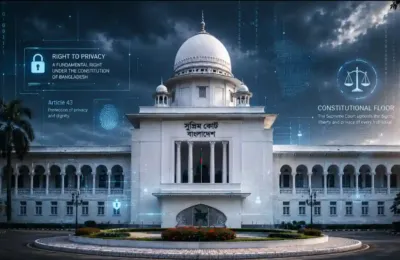
The unfortunate truth is that neither privacy nor data protection is under control. Article 43(b) of our Constitution guarantees the right to privacy. If this right is violated, he or she may file a case under Article 102(1) in the High Court Division. Section 7 of the Right to Information Act of 2009 states that everyone has the right to have their data securely protected.
The Pornography Control Act of 2012 applies when deepfake pornography, nudes, or movies are created utilizing AI technology. However, the effectiveness of these measures may depend not only on the existence of legal provisions but also on how well they are implemented and understood. Potential obstacles include a lack of knowledge about legal remedies, procedural complexity, delays in handling complaints, and uncertainty about enforcement.[11] The Bangladesh Cybersecurity Strategy (2021-25) is one such initiative. However, there is a disparity between technology adoption and regulation due to a lack of AI-specific legislation and institutional expertise.[12]
04. Global Response
In 2018, U.S. Senator Sasse introduced the Malicious Deepfake Prohibition Act, followed by Representative Yvette D. Clark’s DEEP FAKES Accountability Act in 2019.[13] Although these bills failed, President Biden initiated task forces to address cybercrimes in 2022. In the UK, the Online Safety Act was passed in October 2023, criminalizing the non-consensual distribution of intimate deepfakes.[14]
Conversely, China has a strict ban on certain deepfakes but still faces challenges, such as face-swap fraud and AI-generated content impersonating individuals, as seen in a 2023 case involving influencer “Carola Ilai.”[15] Zao, a well-known Chinese software, allowed users to upload their own images and swap out their faces for those of their favourite movie characters. After discovering that the rules of service granted users “perpetual and transferable rights to the data posted” and created significant privacy concerns, WeChat banned the face-swapping software Zao.[16]
The suspected use of pornographic video and audio deepfakes, which entailed posing as a police officer to threaten and extort money from an elderly citizen, was the subject of an ongoing investigation by Indian police in 2023.[17] To escape social disgrace, this fragile elderly man considered suicide. A European Union policy document outlines various harms from reproduced deepfakes, including sextortion, defamation, identity theft, reputational damage, fraud, election manipulation, erosion of trust, and damage to the justice system and democracy.[18]
05. The Barriers
Research indicates that most individuals, including experienced social media users, struggle to detect fake videos, particularly high-quality deepfakes. Studies highlight that while some people can spot low-quality fakes to a degree, the overall ability to identify convincing AI-generated videos remains limited.[19] The challenges countries face include cross-border jurisdiction, identifying malicious actors and authenticating evidence, IP and copyright rights, personality rights related to post-mortem privacy, the need for ongoing research and development, reassessing privacy and data protection, and cybersecurity resources and awareness.[20]
OpenAI’s support website states that the organisation does not guarantee data confidentiality or security, highlighting vulnerabilities in chatbots that could be exploited by attackers to spread malware or steal confidential information. The unregulated use of chatbots reduces accountability and transparency. While tools like ChatGPT have potential benefits for education, their misuse poses risks to innovation, transparency, accuracy, and reliability.[21]
06. The Road Ahead
To enhance user trust in AI-driven fake news predictions, developing explainable AI credibility indicators is vital. These indicators can aid users in identifying credible news. However, further efforts are required to tailor these indicators for low-literate, digitally novice social media users, particularly in non-English languages.[22]
Ensuring compatibility with local language content and providing accessible explanations of AI decision features is crucial. Suggested methods include using colored backgrounds to differentiate fake video types and indicating confidence levels in predictions, aiding comprehension for low-literate users. Efforts to improve media literacy teaching in communities and schools are essential. Governments and communities should educate the public about the harmful effects of technology and social media, emphasizing caution, especially among minors.
Additionally, technology and media companies need to invest in detection tools for deepfakes, enabling viewers to distinguish between real and fake content. Law enforcement agencies should enhance their digital forensic capabilities with machine learning to detect tampering in recordings, verify content authenticity, and trace the origins of AI-generated material.[23] Additionally, there is a need for establishing victim-oriented legal aid mechanisms.
Effective communication should highlight three core strategies: prevention, detection, and repair, making the subject more tangible. Additionally, Bangladesh should adopt a multifaceted approach that includes fast reporting, public literacy, platform accountability, and enhanced local detection capabilities. The uploader should bear the burden of proof rather than the victim. Bangladesh’s sociocultural reality is marked by instantaneous humiliation before content authentication. Prevention should be both cultural and technical. Before reacting to potentially harmful audio or video snippets, media, community leaders, and families must be trained to demand cryptographic or platform-verified authentication. Additionally, it is recommended to establish decentralized “First Responder” Networks at community and campus levels, which would effectively report and expedite the removal of non-consensual synthetic media from social media platforms before it can spread widely. We must remember that, while AI has militarized the pixels, we still have complete control over the narrative and can restore our digital sovereignty.
Key Takeaways: Deepfake Defamation & Legal Landscape in Bangladesh
- The Growing Threat of Deepfakes: AI-generated deepfakes pose severe threats to personal reputation, financial security, and public trust.
- Legal Framework & Gaps: Existing laws like the Penal Code 1860 and Cybersecurity Act 2026 lack comprehensive procedural safeguards against AI-driven defamation.
- Socio-Cultural Impact: Victims face rapid online dissemination and instantaneous social humiliation before content authentication.
- Strategic Road Ahead: Combating deepfakes requires robust technical detection, public media literacy, platform accountability, and victim-oriented legal aid.

2026 Legal Research Professional Certificate
- 1. Anuragini Shirish and Shobana Komal, ‘A Socio-Legal Inquiry on Deepfakes’ (2024) 54(2) California Western International Law Journal 517 <https://scholarlycommons.law.cwsl.edu/cwilj/vol54/iss2/6> accessed 28 July 2026. ↩
- 2. Farah Zahan Shuchy and Md Azaher Uddin, ‘Targeted for Speaking Out: Gendered Disinformation and Digital Resilience in Bangladesh’s Polycrisis’ (2026) 14 Media and Communication <https://doi.org/10.17645/mac.11429> accessed 28 July 2026. ↩
- 3. Md Al-Amin Hossain, ‘Addressing Deepfake through the Existing Legal Strategies in Bangladesh: An Assessment’ (2024) 7(1) International Journal of Law Management & Humanities 2260 <https://ijlmh.com/paper/addressing-deepfake-through-the-existing-legal-strategies-in-bangladesh-an-assessment/> accessed 28 July 2026. ↩
- 4. Md Al-Amin Hossain, ‘Addressing Deepfake through the Existing Legal Strategies in Bangladesh: An Assessment’ (2024) 7(1) International Journal of Law Management & Humanities 2260 <https://ijlmh.com/paper/addressing-deepfake-through-the-existing-legal-strategies-in-bangladesh-an-assessment/> accessed 28 July 2026. ↩
- 5. ‘Bangladesh: Rising Deep Fake Abuse Triggers Social Ruin for Women’ The Hans India (online, 27 April 2026) <https://www.thehansindia.com/news/international/bangladesh-rising-deep-fake-abuse-triggers-social-ruin-for-women-1069242> accessed 28 July 2026. ↩
- 6. ‘Govt implementing measures to curb AI-driven misinformation, deepfakes, minister tells parliament’ The Business Standard (online, 8 July 2026) <https://www.tbsnews.net/bangladesh/govt-implementing-measures-curb-ai-driven-misinformation-deepfakes-minister-tells> accessed 28 July 2026. ↩
- 7. Md Al-Amin Hossain, ‘Addressing Deepfake through the Existing Legal Strategies in Bangladesh: An Assessment’ (2024) 7(1) International Journal of Law Management & Humanities 2260 <https://ijlmh.com/paper/addressing-deepfake-through-the-existing-legal-strategies-in-bangladesh-an-assessment/> accessed 28 July 2026. ↩
- 8. Md Al-Amin Hossain, ‘Addressing Deepfake through the Existing Legal Strategies in Bangladesh: An Assessment’ (2024) 7(1) International Journal of Law Management & Humanities 2260 <https://ijlmh.com/paper/addressing-deepfake-through-the-existing-legal-strategies-in-bangladesh-an-assessment/> accessed 28 July 2026. ↩
- 9. Sowrov Chandro Roy, ‘Bangladesh Cyber Security Act 2026: A Critical Analysis And Solution’ (ResearchGate, June 2026) <https://www.researchgate.net/publication/407139174_Bangladesh_Cyber_Security_Act_2026_A_Critical_Analysis_And_Solution> accessed 28 July 2026. ↩
- 10. Roy (n 9). ↩
- 11. Nowshin Islam, ‘Understanding Online Violence against Women in Bangladesh: Sociocultural Drivers, Legal Awareness, and Institutional Responses’ (2026) 6(1) Scholars Journal of Research in Social Science 16 <https://doi.org/10.5281/zenodo.19882617> accessed 28 July 2026. ↩
- 12. Md Masud Nabi, Mahmuda Akter and Mostak Bari Fahim, ‘The Emerging Threat of Unlawful AI Usage: A Comprehensive Content Analysis in Bangladesh and Worldwide’ (2026) 1(1) Journal of South Asian Issues (JSAI) 140 <https://jsai.uk/index.php/pub/article/view/49> accessed 28 July 2026. ↩
- 13. Anuragini Shirish and Shobana Komal, ‘A Socio-Legal Inquiry on Deepfakes’ (2024) 54(2) California Western International Law Journal 517 <https://scholarlycommons.law.cwsl.edu/cwilj/vol54/iss2/6> accessed 28 July 2026. ↩
- 14. Anuragini (n 13). ↩
- 15. Anuragini (n 13). ↩
- 16. Md Al-Amin Hossain, ‘Addressing Deepfake through the Existing Legal Strategies in Bangladesh: An Assessment’ (2024) 7(1) International Journal of Law Management & Humanities 2260 <https://ijlmh.com/paper/addressing-deepfake-through-the-existing-legal-strategies-in-bangladesh-an-assessment/> accessed 28 July 2026. ↩
- 17. Anuragini Shirish and Shobana Komal, ‘A Socio-Legal Inquiry on Deepfakes’ (2024) 54(2) California Western International Law Journal 517 <https://scholarlycommons.law.cwsl.edu/cwilj/vol54/iss2/6> accessed 28 July 2026. ↩
- 18. Anuragini (n 17). ↩
- 19. Farhana Shahid and others, ‘”It Matches My Worldview”: Examining Perceptions and Attitudes Around Fake Videos’ (2022) Proceedings of the 2022 CHI Conference on Human Factors in Computing Systems <https://doi.org/10.1145/3491102.3517646> accessed 28 July 2026. ↩
- 20. Anuragini Shirish and Shobana Komal, ‘A Socio-Legal Inquiry on Deepfakes’ (2024) 54(2) California Western International Law Journal 517 <https://scholarlycommons.law.cwsl.edu/cwilj/vol54/iss2/6> accessed 28 July 2026. ↩
- 21. Md Masud Nabi, Mahmuda Akter and Mostak Bari Fahim, ‘The Emerging Threat of Unlawful AI Usage: A Comprehensive Content Analysis in Bangladesh and Worldwide’ (2026) 1(1) Journal of South Asian Issues (JSAI) 140 <https://jsai.uk/index.php/pub/article/view/49> accessed 28 July 2026. ↩
- 22. Farhana Shahid and others, ‘”It Matches My Worldview”: Examining Perceptions and Attitudes Around Fake Videos’ (2022) Proceedings of the 2022 CHI Conference on Human Factors in Computing Systems <https://doi.org/10.1145/3491102.3517646> accessed 28 July 2026. ↩
- 23. M Sabbir Ahmed Shihab and others, ‘Victims of AI: Addressing the Legal Response Gap to AI-Related Crimes in Bangladesh’ (2026) 13(2) International Journal of Research and Scientific Innovation 1980 <https://doi.org/10.51244/IJRSI.2026.130200194> accessed 28 July 2026. ↩