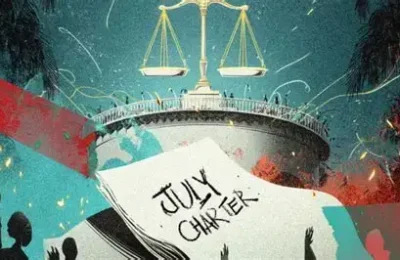
The July Charter proposes a fundamental shift in Bangladesh’s legislative structure: a bicameral parliament where the Upper House is formed through Proportional Representation (PR). Under this system, members of the Upper House would be elected based on the total percentage of votes each party receives nationwide. Conversely, the Bangladesh Nationalist Party (BNP) has registered a Note of Dissent, arguing for a seat-based Upper House—meaning representation would be strictly proportional to the number of Members of Parliament (MPs) a party secures in the Lower House.
The Threat of a Rubber-Stamp Legislature
What are the legal and political implications of this disagreement? If the Upper House is formed using the seat-based model, it simply becomes a “copy-paste” of the main parliament. Consequently, the Upper House will lack the independence to veto controversial legislation, as the ruling party will comfortably command majorities in both chambers.
- The PR Model: Upper House reflects the total popular vote, ensuring smaller parties and alliances have a strong legislative voice.
- The Seat-Based Model: Upper House mirrors the Lower House, granting the ruling party dual legislative dominance.
- The Article 70 Trap: Anti-defection laws prevent MPs from voting their conscience, nullifying internal democratic checks.
- The Amendment Threat: Absolute majorities in both houses could allow unilateral constitutional changes.
The Shadow of Article 70
This structural flaw is dangerously exacerbated by Article 70 of our current constitution. Under this provision, MPs automatically lose their parliamentary seats if they vote against their party line. Therefore, even if a ruling party MP wishes to vote against a controversial bill based on their conscience, the constitution affords them no opportunity to do so.
In this scenario, a seat-based Upper House becomes an entirely ineffective institution. It would be a waste of taxpayer money that serves only to provide double validation for the ruling party to consolidate power. There would be no effective parliamentary mechanism to block the passage of “black laws,” nor would there be a platform to protect the constitutional role of the opposition.
A Blueprint for Democratic Reform
Crucially, the absolute two-thirds majority required under Article 142 to amend the constitution would be easily attainable for a dominant ruling party across both houses. This dynamic clearly contradicts the spirit of the July Charter. It leaves the implementation of vital constitutional reforms entirely dependent on the goodwill of the ruling party.
What is the solution to this impending crisis?
- Implement Proportional Representation: The mandate for an Upper House based on the PR system won by a massive margin during the national referendum. Therefore, the ruling BNP and all opposition alliances must ensure a balanced legislature by forming the Upper House with representatives proportional to the total votes cast nationwide.
- Amend Article 70: During the very first session of parliament, Article 70 must be fundamentally amended. The anti-defection rule should be restricted to apply only to votes of “no-confidence.” For all other legislation, MPs must be granted the constitutional right to vote independently.
- Codify the July Charter: Above all, the core clauses of the July Charter that were included and validated in the referendum ballot must be constitutionally enshrined without delay.
Conclusion
Finally, a warning to the current leadership: You have assumed power on the foundation of the blood shed in July. If you cannot deliver a state built on minimum justice and democratic checks, the people of this country will not hesitate to bring back the spirit of a “Red July.” They have fought for freedom for ages, and they will continue to fight.
Long live the revolution.