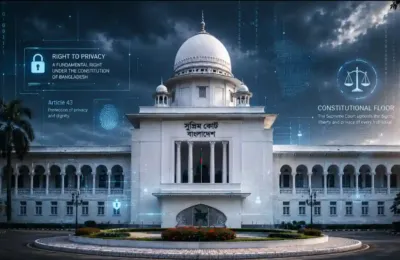
The Bangladesh Constitutional Crisis of 2024 brought a searing focus onto the country’s founding legal paradox. In Bangladesh, the Constitution begins with a striking assertion: “All powers in the Republic belong to the people.” It’s not a footnote or an afterthought—it’s the opening line. This phrasing, inherited from the spirit of 1971, echoes the founding vision of a people-centered republic. But in practice, that promise has aged poorly. What was intended as a bold expression of popular sovereignty has become more of a ceremonial gesture than a lived reality.
The machinery of constitutional change in Bangladesh is dense, slow-moving, and sealed off from direct public influence. According to Article 142, amending the Constitution requires a two-thirds vote in Parliament—no small feat, and by design. The rationale is understandable: significant changes to the country’s foundational document should carry broad political consensus. But there’s a downside to this structure, and it’s grown harder to ignore. The public, whose will the Constitution claims to represent, has no formal say in reshaping it.
That tension—between the people’s proclaimed ownership of the state and their actual exclusion from its core processes—reached a breaking point in 2024. The Anti-Discrimination Student Movement (AdSM), which began over longstanding frustrations with the public job quota system, erupted into something larger and more destabilizing. By mid-year, protesters were no longer just demanding revised policy. They were calling for the Constitution itself to be dismantled and rewritten from the ground up.
It was not a fringe demand. It was loud, organized, and unignorable.
The government, cornered and reeling, watched as the protest movement snowballed into a nationwide reckoning. The unprecedented scale of the Bangladesh Constitutional Crisis 2024 led to the dissolution of Parliament and the appointment of an interim government. Prime Minister Sheikh Hasina stepped down. Parliament was dissolved. An interim government was appointed. And the question that had lingered on the margins of legal debates for years finally exploded into public view: What does it mean for a people to be sovereign if they can’t touch their own Constitution?
To answer that, it helps to look at how constitutional reform is understood in legal theory. Bangladesh’s Parliament, under current law, holds what’s called derivative constituent power—meaning, it can make amendments to the Constitution, but only within the parameters set by the original constituent authority: the 1972 Constituent Assembly. That Assembly, formed at a moment of national rebirth, continues to cast a long shadow over constitutional legitimacy. Parliament cannot override or recreate that founding moment; it can only work within it.
Moreover, Parliament’s amending power isn’t unlimited. In 1989, the Supreme Court introduced a major constraint by adopting the “basic structure doctrine” in Anwar Hossain Chowdhury v. Bangladesh. Borrowed from Indian jurisprudence, the doctrine holds that certain features of the Constitution—like the independence of the judiciary, the republican form of government, or the unitary state structure—are so foundational that even a supermajority in Parliament cannot alter them. That decision was seen, rightly, as a check against political overreach. But it also entrenched a paradox: the very Constitution that says all power belongs to the people simultaneously tells them that certain changes are off-limits, even if a majority wants them.
For many in 2024, that contradiction came to define the crisis.
The protests, though student-led, struck a broader national nerve. The demand was not for policy reform but structural overhaul. Calls for a new Constitution gained momentum, with slogans in Dhaka and Chittagong invoking not just justice but rebirth. It wasn’t just a political uprising—it was, arguably, a constituent moment: one of those rare junctures in which the public asserts its claim to remake the state from scratch, not merely amend it.
In response, the interim government announced the formation of a Constitution Reform Commission. The symbolism was deliberate. It acknowledged, perhaps for the first time since the original Constitution was written, that the people had seized back the authorship of their legal future. But the path forward remains foggy. Bangladesh lacks the legal infrastructure to navigate this kind of moment. There’s no formal mechanism for calling a constitutional convention. No framework for a referendum. No process for direct public participation in constitutional writing. The law, in its current state, is silent on what to do when the public demands more than incremental change.
Comparative experience can offer guidance—though not always answers. In France, constitutional amendments can be passed through referendum, giving the people a direct voice in foundational questions. It’s not often used, but when it is, it grants changes a level of legitimacy that parliaments alone can’t confer. The French model would be a meaningful starting point for Bangladesh to consider.
China represents the opposite extreme. Though its Constitution speaks of the people as sovereign, the reality is tightly controlled from the top. Amendments are the sole purview of the National People’s Congress. There’s no meaningful public consultation, and certainly no referenda. The process is swift, centralized—and opaque. Bangladesh has struggled with centralization in its own political history. Emulating the Chinese model would only deepen the distance between the governed and the governing.
The UK, meanwhile, offers a reminder that tradition alone doesn’t guarantee democratic legitimacy. Without a written constitution, the UK leaves most constitutional questions to Parliament, with referenda used sparingly. But even this flexible model has shown cracks. Brexit, for all its democratic appearance, left behind legal uncertainty and political fragmentation. The lesson for Bangladesh isn’t to avoid public votes—it’s to structure them with clarity, purpose, and legal safeguards.
Bangladesh needs a mechanism that reflects its history and honors its constitutional promises. A referendum law could be introduced for major constitutional reforms. A special constituent assembly—separate from Parliament—could be elected to rewrite the Constitution with a public mandate. Or a hybrid process could be created, one in which Parliament drafts amendments and the public ratifies them. Each path has merits. But what they share is a re-centering of the people in a process that, by rights, should belong to them.
The events of the Bangladesh Constitutional Crisis 2024 laid bare what legal scholars have long suspected: Bangladesh’s constitutional framework is no longer capable of responding to the country’s democratic aspirations. The legal tools are too rigid. The structures too insular. And the public, tired of waiting, has already begun to write its demands in the streets.
A Constitution that opens by declaring that power belongs to the people must do more than echo their sovereignty. It must make room for their voices when the time comes to start again.